Two faint dips worth a second look
I searched archived Kepler data for small, repeating dips in the light of faint stars. Two signals held up through my checks. Neither is confirmed, and both have explanations I have not ruled out.
How I looked
Kepler watched one patch of sky for about four years, and most of the stars in its frames were never chosen as targets. The Kepler Bonus project (Martínez-Palomera et al. 2023) published light curves for those faint stars. I searched quarters 1 to 12 for transits and fixed the best signals. I then measured each one once in quarters 13 to 17, which I had set aside. Those quarters use the same processing, so they are a consistency check and not independent confirmation. Last, I used the pixels to see which star each dip sits on.


Candidate A
KIC 4916729 · Gaia DR3 2101067872016210432 · TIC 394175680
A faint star dims by about 0.1% every 15.2 days.
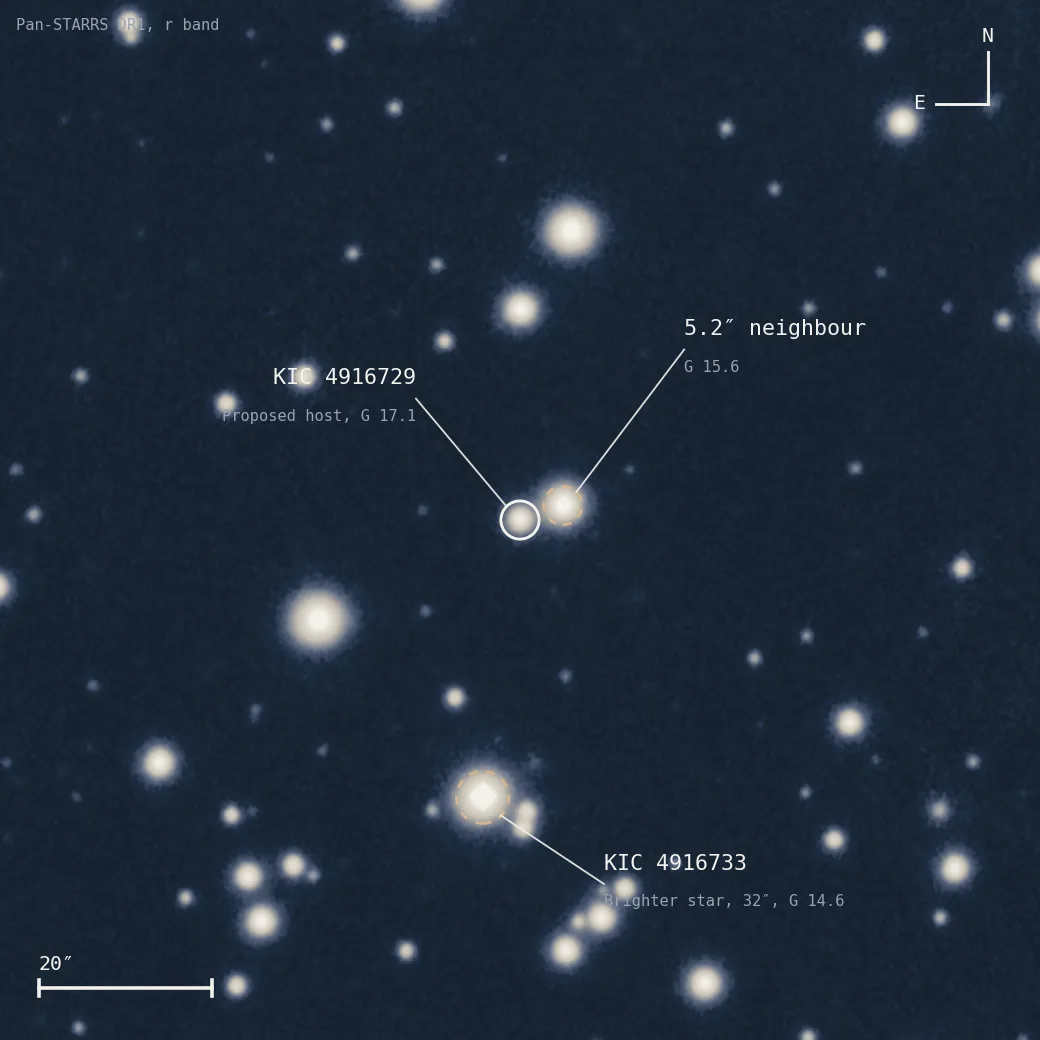
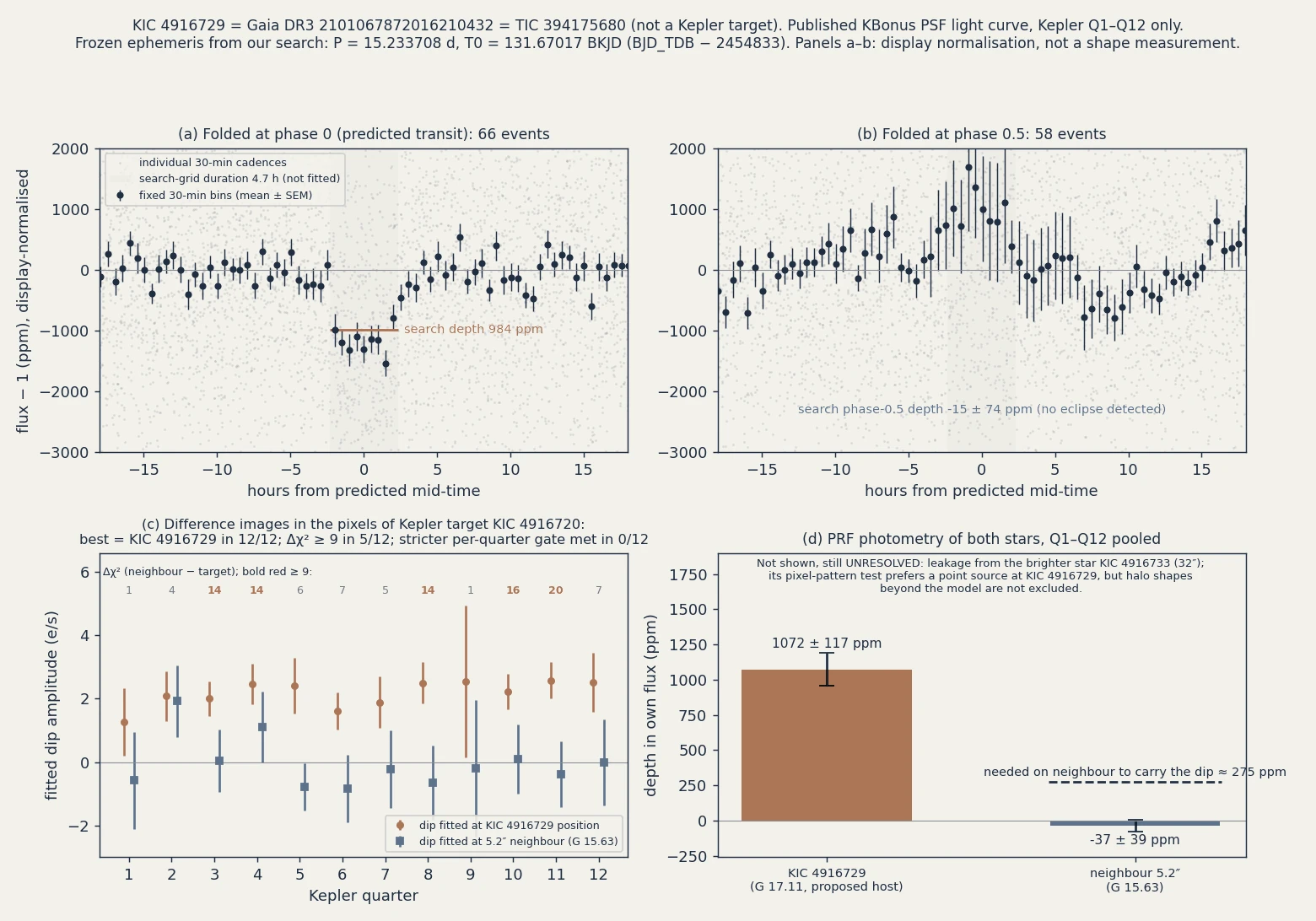
KIC 4916729 (Gaia G 17.1) was never a Kepler target. Its pixels were recorded inside the frame of KIC 4916720. Every 15.23 days it dims by about 0.1% for roughly 4.7 hours. If it hosts a planet, the planet would be about 2.9 to 4.3 Earth radii, assuming a Sun-like star (0.85 to 1.15 solar radii) and no extra dilution from other stars.
- Period
- 15.233708 d
- First transit
- 131.670165 BKJD
- Depth
- 984 ppm in Q1 to Q12
- Duration
- 4.7 h (a search value, not a fit)
- Possible size
- 2.9 to 4.3 Earth radii
What I found
- The dip has a signal to noise of 13.6 in Q1 to Q12. In the quarters I set aside it measures 1157 ± 116 ppm over 26 transits, with the same processing.
- Odd and even dips agree (0.07σ), and nothing shows at phase 0.5, so I see no second eclipse.
- The period and timing match none of 46,472 catalogued Kepler planet candidates, false positives and eclipsing binaries.
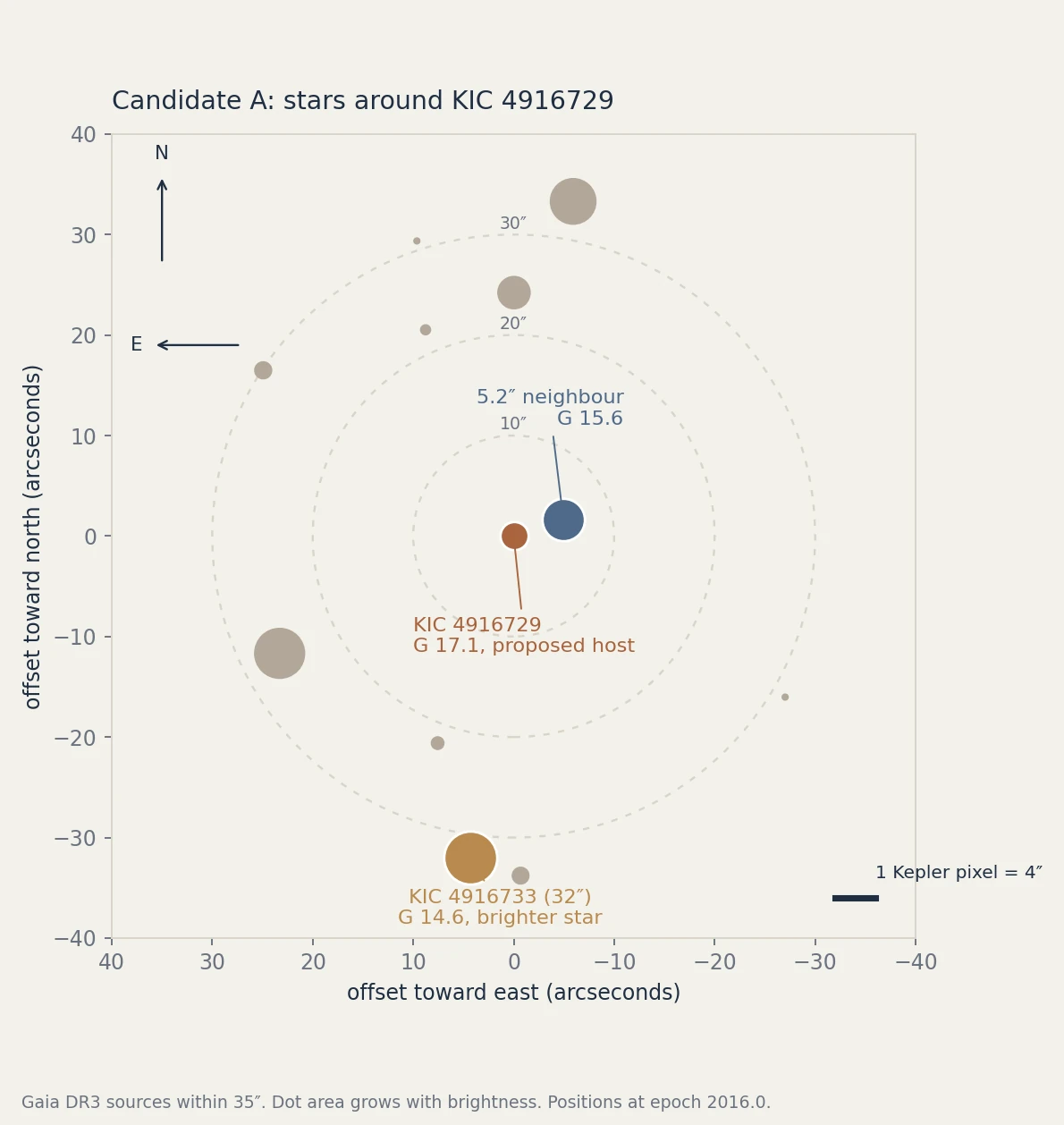
- A star 5.2″ away could have been the source. Difference images favour my star in all 12 quarters, but strongly in only 5. Brightness fits give my star 1072 ± 117 ppm and the neighbour -37 ± 39 ppm. The neighbour would need about 275 ppm.
What is still open
- Light from the brighter star KIC 4916733, 32″ away. My star's pixel pattern fits a point source better than two smooth halo models, and ZTF shows no eclipse of 2% or more on that star. Halo shapes outside my models are untested, so this stays unresolved.
- An eclipsing binary blended within 1 to 2″ or bound to the star, including an equal-eclipse pair at 30.47 d.
- A 15.0 to 15.6 d systematic band in my own control light curves. I disfavour it but have not excluded it.
- I have not measured the dip's shape or the star's density, and I have not checked the non-KOI DR24 threshold crossings, so I cannot say the signal is new.
Are 15-day dips, or leakage from a star 32″ away, known artefacts in Kepler Bonus light curves of faint sources? Which diagnostic should I check first?


Candidate B
KIC 10976416 · Gaia DR3 2129657923114028544 · TIC 424864511
A dip Kepler found on a red giant fits the small star next door.
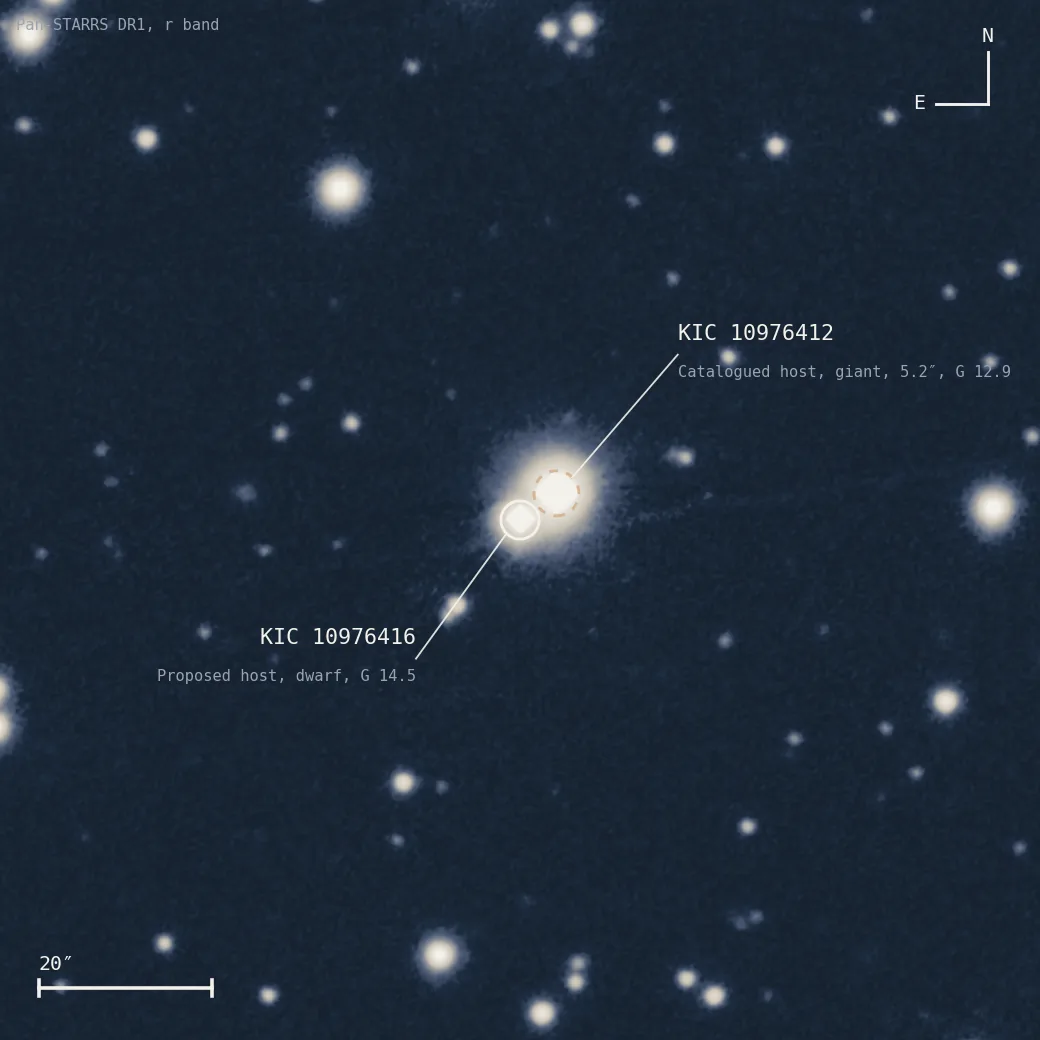
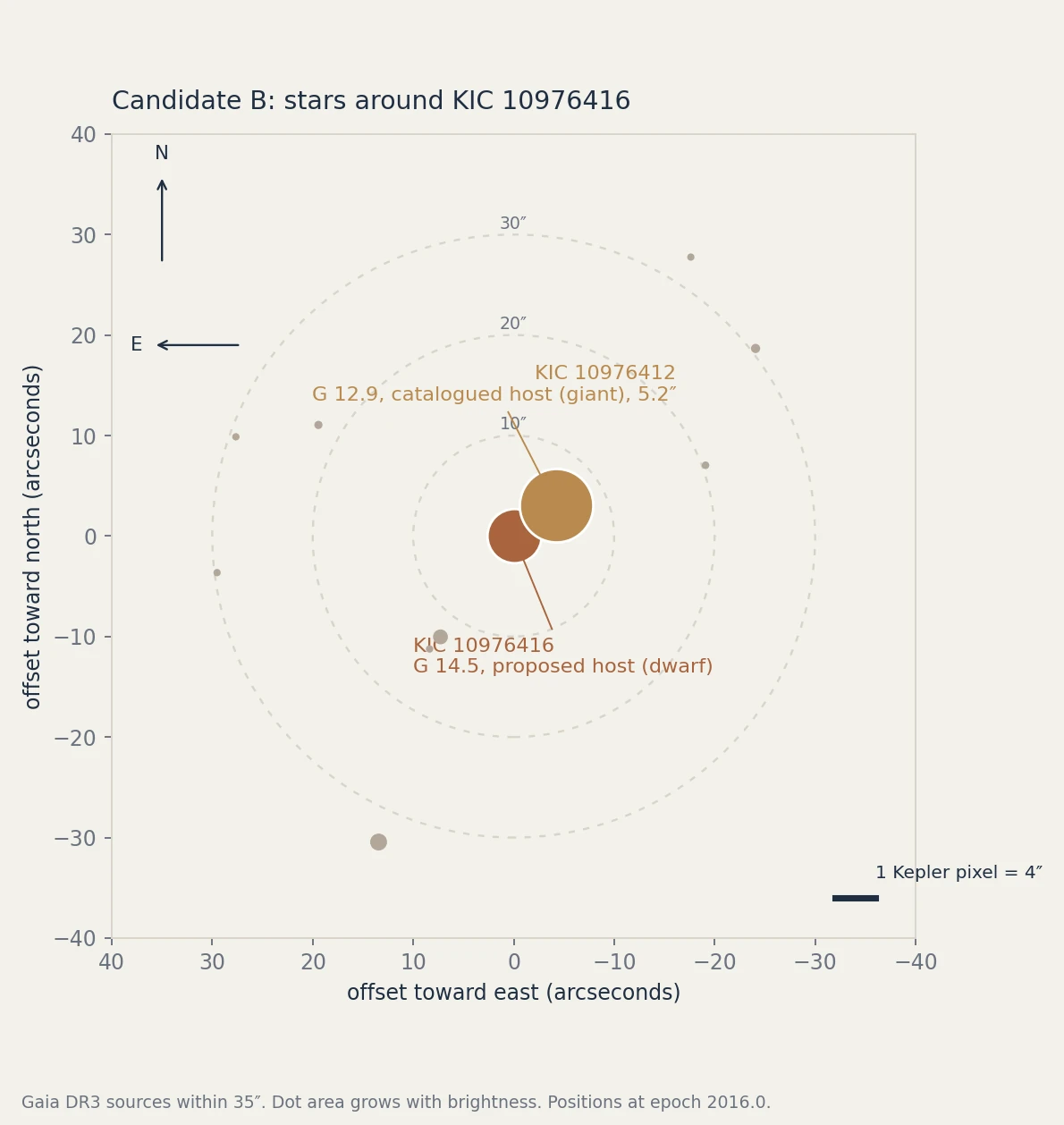
Kepler already knew this dip. It is KOI K07393.01, found on the red giant KIC 10976412 (G 12.9) and marked a false positive because its position did not match that star. I find it fits better on the dwarf KIC 10976416 (G 14.5), 5.2″ away. This is a proposed new host for a known signal, not a new signal.
If the dwarf is the host, the planet would be about 1.9 to 2.0 Earth radii, using the dwarf's estimated size (0.58 to 0.61 solar radii, no spectrum) and assuming no extra dilution.
- Period
- 3.7593805 d
- First transit
- 134.14201 BKJD
- Depth
- 898 ppm in Q1 to Q12
- Duration
- 1.2 h (the shortest I search; the KOI value is 1.19 ± 0.14 h)
- Proposed host
- KIC 10976416, G 14.5
- Catalogued host
- KIC 10976412, G 12.9
- Possible size
- 1.9 to 2.0 Earth radii
What I found
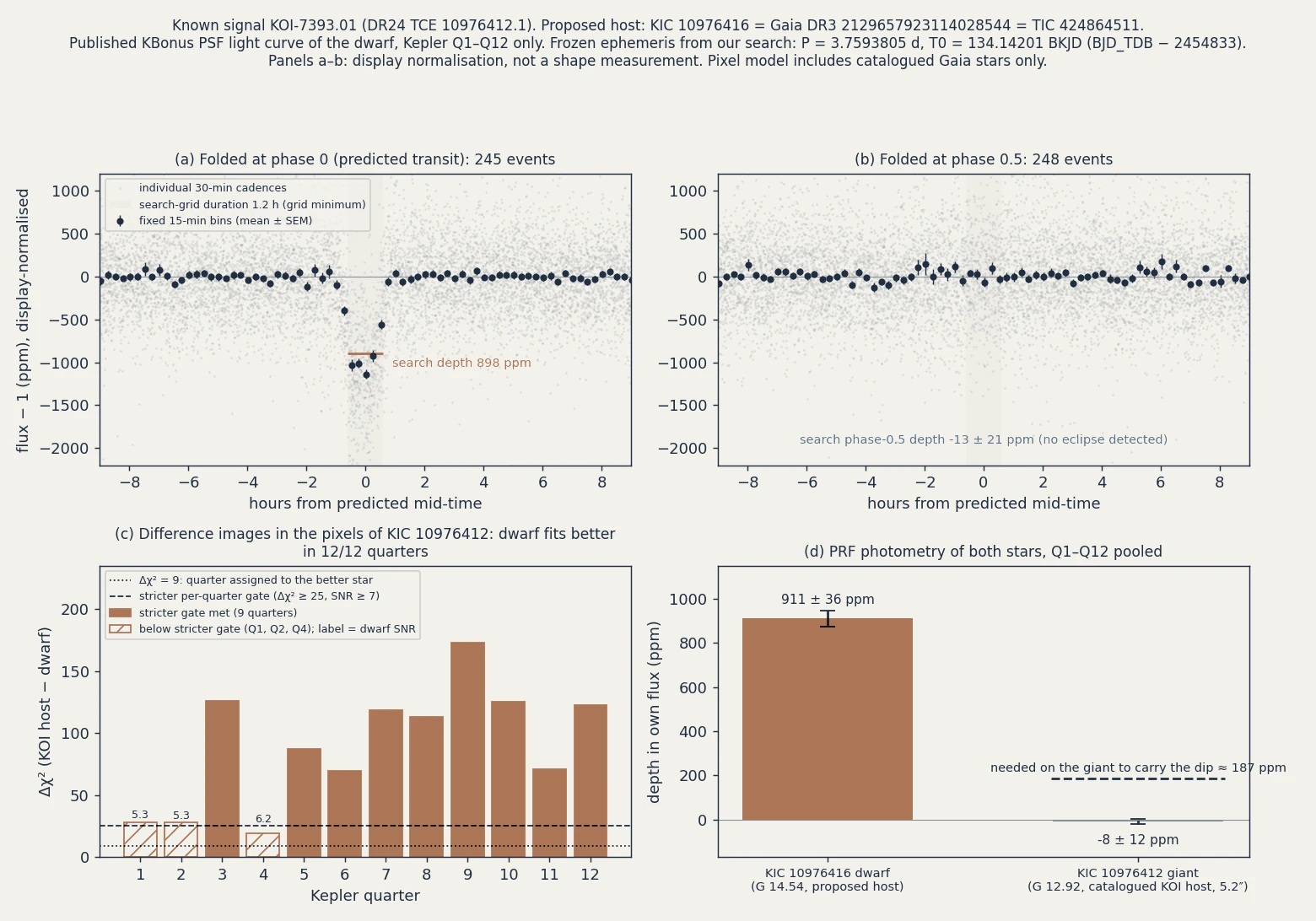
- The dip has a signal to noise of 52.9 and is above 3σ in all 12 quarters. In the quarters I set aside it measures 900 ± 24 ppm, with the same processing.
- Odd and even dips agree (1.5σ), and nothing shows at phase 0.5. Kepler's own position for the dip is 0.22 ± 0.14″ from the dwarf.
- Difference images fit the dwarf better than the giant in all 12 quarters, and pass my stricter test in 9. The weaker ones are Q1, Q2 and Q4. Brightness fits give the dwarf 911 ± 36 ppm and the giant -8 ± 12 ppm, where the giant would need about 187 ppm. Test dips I injected were recovered in every quarter.
What is still open
- An eclipsing binary blended within 1 to 2″ or bound to the dwarf, including an equal-eclipse pair at 7.52 d.
- Faint stars 12 to 14″ away that are outside my pixel model, or wrong stellar parameters for the dwarf.
- I have not measured the dip's shape or the star's density. The published DR25 positional probability for K07393.01 may already favour the dwarf, and I have not retrieved it.
Does a published positional analysis already assign K07393.01 to KIC 10976416? If not, is high-resolution imaging the right next test?
Where this stands
- Both are unconfirmed exoplanet candidates, now waiting for outside expert review. The questions above go to specialists next.
- Each has a test still open. Candidate A needs checking for light from a brighter nearby star. Candidate B needs checking for an eclipsing binary.
- I do not know yet whether Candidate A is new. Candidate B is a known signal with a proposed new host.
The code, data and full briefs will be open source. I will add them here once the repository is public.